“Critical Flaw in DRIP Policy: No Fuel Allocation Slows Road Reshaping Across Ghana” – DRIP Coordinator
“Critical Flaw in DRIP Policy: No Fuel Allocation Slows Road Reshaping Across Ghana” – DRIP Coordinator
 Hamza Mohammed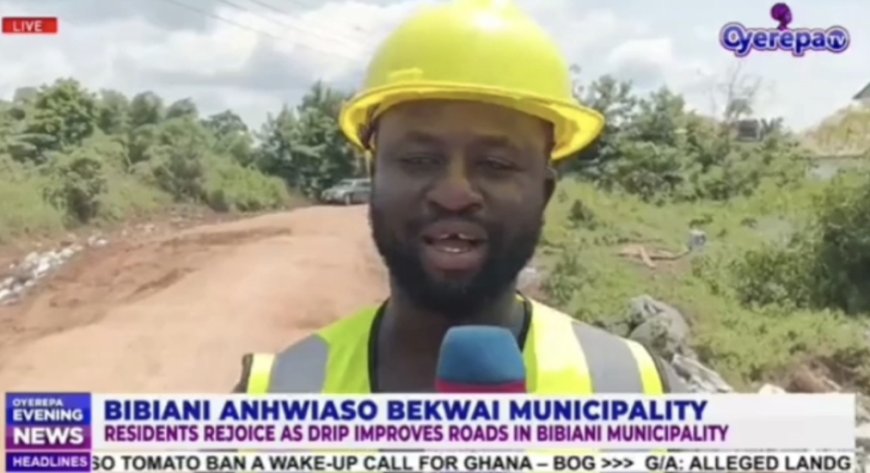
“Critical Flaw in DRIP Policy: No Fuel Allocation Slows Road Reshaping Across Ghana” – DRIP Coordinator
The Bibiani-Anhwiaso-Bekwai Municipal Coordinator for the District Road Improvement Programme (DRIP), Mr. Emmanuel Achampong, popularly known as Legacy, has raised concerns over a major policy gap affecting the smooth implementation of the initiative across the country.
Speaking to the media, Mr. Achampong highlighted the absence of fuel provisions within the DRIP framework, describing it as a critical oversight that is hindering effective operations on the ground. According to him, while the programme was introduced to improve road conditions in districts nationwide, essential logistical components—particularly fuel for machinery—were not adequately captured.
He explained that fuel is a fundamental requirement for the operation of road construction equipment, and its omission has created serious challenges for coordinators tasked with executing projects.
“Machines cannot operate without fuel, and unfortunately, this was not captured under the programme. This has made it difficult for us to consistently carry out the reshaping of deplorable roads across the municipality,” he stated.
Mr. Achampong noted that the situation is already impacting ongoing road reshaping efforts within the Bibiani-Anhwiaso-Bekwai Municipality, slowing progress and putting additional pressure on local authorities.
Despite these challenges, he commended the Municipal Chief Executive (MCE) and the Member of Parliament (MP) for their timely intervention. He revealed that both officials have taken it upon themselves to support the programme by covering fuel costs to ensure that work continues.
“For instance, the ongoing reshaping of poor roads within our municipality is being sustained largely through the support of the MCE and the MP, who are bearing the cost of fuel to keep operations running,” he added.
Mr. Achampong therefore called on government and relevant stakeholders to urgently review and strengthen the DRIP policy framework by incorporating fuel and other critical logistics. He stressed that such adjustments are necessary to enhance efficiency, ensure sustainability, and enable the programme to achieve its intended impact.
The District Road Improvement Programme remains a key intervention aimed at improving road networks and boosting economic activities at the local level. However, stakeholders believe that addressing these operational gaps is crucial to ensuring its success across municipalities nationwide.
Source:Bibianinews.com